https://www.aexception.com/the-sony-evolution-from-post-war-radio-to-global-media-powerhouse/
Introduction: A story of entrepreneurship in the ruins of the post-war era
When we mention Sony, perhaps the first thing that comes to your mind is PlayStation, noise-canceling headphones, or the movie rights to Spider-Man. But in the history of this Japanese company, its beginnings were much simpler and more difficult than these high-tech products.
In 1945, in the devastated post-war Tokyo, an inconspicuous workshop-type company was quietly established. There was no office building, not even a complete window, but this team of only a few people opened the prelude to a brand that changed the world.
So how did Sony go from being a simple radio to a global consumer electronics giant? Let’s start from the beginning.
Start-up period: Entrepreneurs who started from radio modification
A small company born out of the ruins of the post-war period
The founders, Masaru Ibuka and Akio Morita, were both typical “entrepreneurs in troubled times.” At first, the company was called “Tokyo Telecommunications Industry Co., Ltd.” and had almost nothing: no capital, no equipment, no raw materials. But the post-war Japanese were eager for world news, and Ibuka opened up the market with a “black technology” – he could transform a radio that could only listen to local Japanese channels into a version that could receive overseas radio stations.
This modification business became Sony’s first pot of gold.
Failed rice cooker and electric blanket
After earning their first fortune, Ibuka and Morita tried to develop their own original products, such as rice cookers and electric blankets. However, the reality was not good – the rice cooker either cooked into crusty rice or did not cook at all; the electric blanket was even worse, either burning the mat or short-circuiting and smoking. The difficulty of starting a business far exceeded their imagination.
Turning point: The tape material accidentally exploded
Faced with difficulties, the team decided to look for a product with higher technical threshold and more prospects. They targeted the scarce magnetic tape materials at that time.
In an accidental experiment in the kitchen laboratory, they used a frying pan to heat and accidentally created a new material that could replace the expensive and difficult-to-obtain tape raw materials. This breakthrough became Sony’s true “technological foothold.”
In 1952, they launched their first tape recorder. Although the product was crude, it was enough to fill a gap in the domestic Japanese market and was widely adopted by schools and journalists.
Expanding into the US market: The transistor revolution
Transistor Opportunities
At the same time, Bell Laboratories in the United States invented the transistor, a miniaturized electronic component that brought the entire electronics industry into the era of portability.
Ibuka and Morita were keenly aware that if transistors were used in radios, they could create products that were smaller than any other device on the market. They took huge financial risks, invested heavily in introducing transistor technology, and established a research and development team to try to overcome the stability and output power issues of transistors.
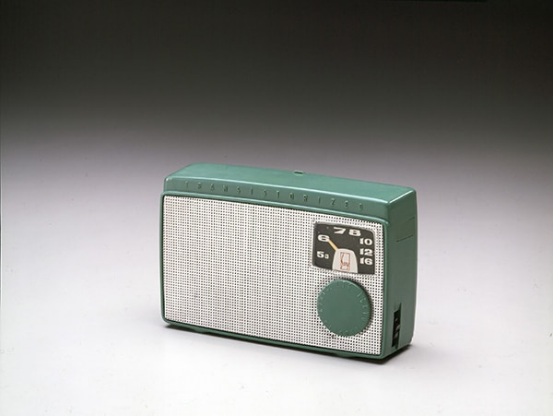
The first transistor radio: TR-55
In 1955, Sony launched the TR-55, Japan’s first transistor radio. This compact and portable product ushered in a new era of personal portable music listening. However, when they tried to enter the US market, they encountered a small problem: the original Japanese pronunciation of the company, “Tokyo Tsushin”, was simply unpronounceable to Americans.
So they decided to rename the company and adopt the more international “Sony” as the brand name, inspired by the Latin word “sonus” (sound) and the nickname “Sonny” commonly used by young Americans at the time.
Global hit: TR-63 brings music to freedom
Although the TR-55 received a good response in the Japanese market, it was the TR-63 launched in 1957 that really brought Sony into the international arena. This radio was not only portable, but also satisfied the needs of young people to listen to rock music secretly in their rooms with its excellent sound quality, which contributed to the rise of rock culture in the 1950s.
Music history experts have commented that the TR-63 was the key device that “brought rock and roll from the stage to the teenage bedroom.”
Sony Spirit: Continuously Breaking Through Technological Boundaries
Sony’s story goes far beyond radio. From the Walkman, Trinitron color TV, PlayStation game console, to digital imaging, semiconductor sensors, and film entertainment, Sony has always continued to explore different fields and strive to break industry boundaries.
And all of this stems from the original spirit of insisting on innovation amidst the ruins.
Conclusion: A radio’s revelation to the world
The rise of Sony proves that technological innovation is not just a competitive tool among large companies. It is essentially a combination of keen insight into the needs of the times and technological breakthroughs.
Are you thinking today: In this rapidly changing era, how can we find our own “transistor moment”?
Feel free to share in the comments section. In your opinion, who will be the next small company to change the world like Sony?
https://www.aexception.com/the-sony-evolution-from-post-war-radio-to-global-media-powerhouse/